The bench press is not a personality test, a chest-size competition, or proof that you belong in the gym. It is one useful strength exercise. Done well, the bench press builds your chest, shoulders, and triceps while giving you a clear way to measure progress. Done badly, it becomes a weekly argument with your shoulders. I want the first version for you.
If you are 30, 40, or 50 and trying to get stronger while losing fat, you do not need a heroic program. You need two or three well-planned pressing sessions each week, enough protein, sensible calories, and the patience to repeat the basics. Eat enough. Train hard. Repeat.
What the bench press actually trains
The standard barbell bench press uses several muscles at once. Your pectoralis major supplies much of the pressing force, while the triceps straighten your elbows and the front deltoids help move the weight. Your upper back, feet, and trunk create a stable platform. That last part matters. A strong press is not just arms pushing a bar away from your body.
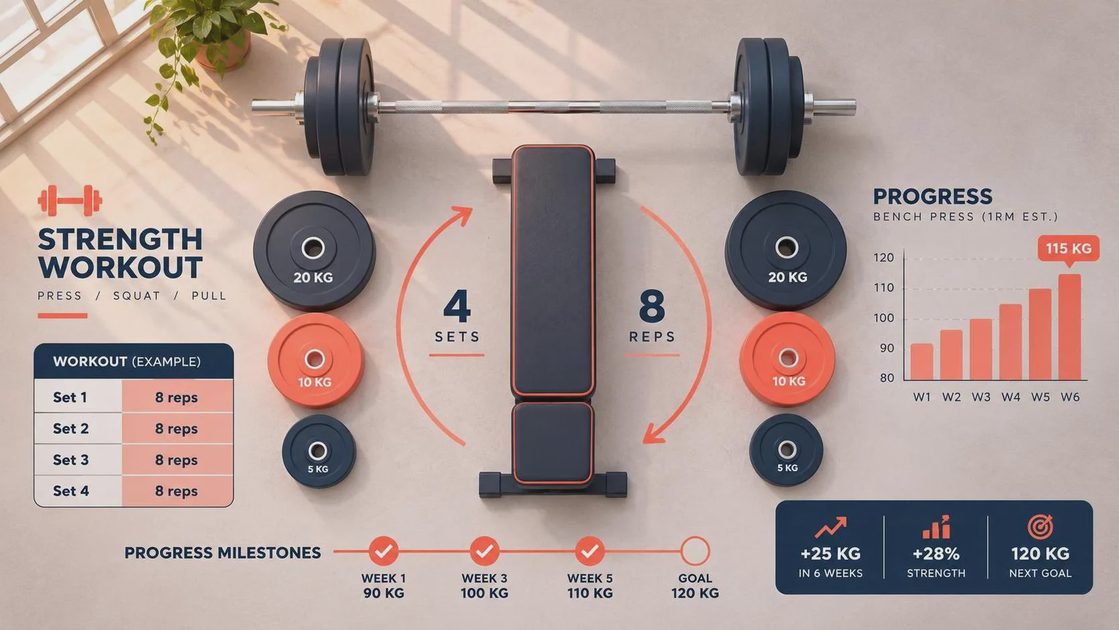
The exercise also gives you a measurable training target. If you press 95 pounds for eight clean repetitions today and 105 pounds for eight several months from now, you have become stronger. That progress can happen even when your scale weight barely changes. If fat loss is your goal, that is useful information: the scale is one data point, not the entire report card.
For most adults, two weekly sessions work well. One can emphasize moderate repetitions, such as three sets of eight at a challenging but controlled weight. The other can use four sets of five with a little more load. Leave one or two good repetitions in reserve instead of grinding until the bar stalls. Your joints and your next workout will thank you.
Bench press form that protects your progress
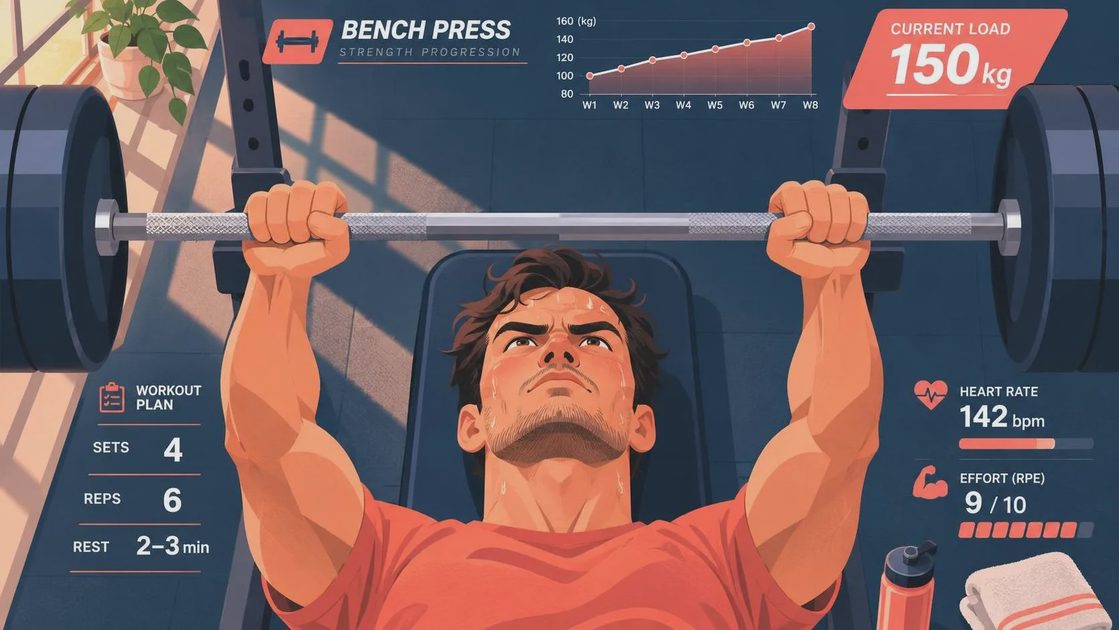
Set your eyes under the bar, plant both feet, and pull your shoulder blades gently back and down. Keep your upper back in contact with the bench. A small natural arch is fine; you do not need to imitate a competitive powerlifter. Grip the bar firmly, with wrists stacked over elbows rather than folded backward.
Lower the bar toward the lower portion of your chest with control. The exact touch point depends on your arm length and grip, but the bar should travel in a repeatable path. Lightly touch the chest without bouncing, then press upward and slightly back toward the starting position. Keep your elbows angled somewhat toward your ribs instead of flaring them straight out.
Use a spotter for heavy barbell work, or set the safety pins just below chest level in a power rack. If neither option is available, dumbbells are often the smarter choice. Stop a set if you feel sharp pain, numbness, or a sudden loss of control. Muscle effort is normal. Joint pain is a signal to change something, not a badge of commitment.
How to choose weight, sets, and repetitions
Start with a weight you could lift for two more repetitions than the plan requires. If your target is three sets of eight, choose a load that allows eight smooth repetitions without twisting, bouncing, or turning the final rep into a wrestling match. Rest two to three minutes between challenging sets. Five minutes is reasonable after a heavy set; scrolling for twenty minutes is not a recovery strategy.
Add weight slowly. A five-pound increase on a barbell can be a large jump when you are already working near your limit. If your gym has one- or two-and-a-half-pound plates, use them. Otherwise, add one repetition per set before increasing load. For example, progress from three sets of six to three sets of eight, then add five pounds and return to three sets of six.
A practical four-week block might look like this. Week one uses three sets of eight at 95 pounds. Week two repeats the weight and aims for cleaner repetitions. Week three moves to 100 pounds if all sets were controlled. Week four reduces the load by about 10 to 15 percent while keeping the movement crisp. That lighter week is training, not failure.
Bench press variations for real-life schedules
The barbell is not mandatory. A dumbbell bench press lets each arm work independently and often feels more comfortable for people with uneven shoulders. Use three sets of eight to ten, and start lighter than your ego requests. The incline dumbbell press shifts some emphasis toward the upper chest and front shoulders, while a neutral grip can reduce wrist or shoulder irritation.
A machine chest press is perfectly respectable, especially when you train alone or are learning how to control resistance. It provides stability so you can focus on pushing through a complete range of motion. Push-ups also count. Elevate your hands on a bench if a floor push-up is too difficult, or place your feet on a step if regular repetitions are easy.
Choose the variation you can perform consistently. The best exercise is not the one that looks most impressive on social media. It is the one you can repeat on a busy Tuesday without pain, complicated setup, or a twenty-minute search for the right equipment.
Nutrition for stronger pressing
Strength training does not cancel out under-eating. If you are trying to lose fat, use a modest calorie deficit rather than slashing food. A practical starting point is roughly 300 to 500 fewer calories than your maintenance intake, then adjust based on two to four weeks of body-weight trends and gym performance.
Protein helps support muscle repair and fullness. For many active adults, about 1.2 to 1.6 grams per kilogram of body weight per day is a reasonable target. Spread it across three or four meals: Greek yogurt at breakfast, chicken or tofu at lunch, cottage cheese or beans at dinner. You do not need a neon-colored supplement to make progress.
Eat some carbohydrate before training if it improves your performance. A banana and yogurt, toast with peanut butter, or oatmeal with milk can provide useful fuel one to two hours before lifting. Afterward, eat a normal meal containing protein, carbohydrates, and produce. Your muscles do not require a magic twenty-minute window, but they do require enough total food over the day.
The plan for this week
Pick two nonconsecutive days. On the first, perform a bench press warm-up with the empty bar, then three sets of eight at a weight you can control. On the second, use four sets of five at a slightly heavier load, stopping before form breaks. Add one row or pulldown exercise for every pressing session, plus a lower-body movement such as a squat, hinge, or step-up.
Write down the weight, repetitions, rest time, and any discomfort. That notebook will tell you more than a random online challenge. If performance improves and pain stays quiet, continue for four weeks before changing the program. If your shoulders complain, reduce the load, shorten the range only temporarily, try dumbbells, and seek a qualified clinician for persistent symptoms.
The bench press can be a reliable tool for building strength while you lose fat, but it is not the whole plan. Sleep enough to recover, eat regular meals, train your back and legs, and stop chasing dramatic transformations. A clean set repeated for months beats a reckless personal record followed by six weeks of soreness. Do the boring work. That is how the numbers move.
No comments yet — be the first to share a thought.