You don't need 15 exercises. You need squat, hinge, push, pull, and carry.
Here's something I tell every single client who walks into my telehealth practice: if you're doing more than five exercises per workout, you're probably wasting your time.
The fitness industry wants you to believe you need variety—different machines, different angles, different "muscle confusion." That's marketing, not science. What actually drives fat loss and muscle preservation is compound movements—exercises that engage multiple muscle groups and multiple joints at the same time.
You don't need 15 exercises. You need five movement patterns. Master these, and you've covered 90% of what your body needs.
Here they are.
The Big Five Movement Patterns
Every functional, effective strength program is built on these five pillars. They're not fancy. They're not new. They're the boring, evidence-based foundation that actually works.
1. The Squat (Lower Body Push)
What it is: Any movement where you bend your knees and hips to lower your body, then stand back up.
Muscles worked: Quadriceps, hamstrings, glutes, lower back, core.
Why it matters: The squat is the king of all lifts. It targets the largest muscle groups in your body—your legs and glutes. More muscle mass activated means more calories burned during and after the workout. It also demands core engagement for stability, which means better posture and less back pain over time.
How to start (beginner): Goblet squat. Hold one dumbbell vertically against your chest, feet shoulder-width apart, squat down like you're sitting back into a chair. Keep your chest up, knees tracking over your toes. Three sets of 10–12 reps.
How to progress: Barbell back squat.
2. The Hinge (Lower Body Pull / Posterior Chain)
What it is: Any movement where you bend at the hips—not the waist—while keeping your back straight, pushing your hips backward.
Muscles worked: Hamstrings, glutes, lower back, core.
Why it matters: The hinge is the deadlift pattern. It works your entire posterior chain—the muscles on the back of your body that most people neglect. A strong posterior chain means better posture, less lower back pain, and a stronger, more athletic physique. Research shows that deadlifts and other hinge movements lead to greater calorie burn than isolation exercises like bicep curls.
How to start (beginner): Dumbbell Romanian deadlift (RDL). Stand with feet hip-width apart, holding a dumbbell in each hand in front of your thighs. Push your hips back, lower the dumbbells down your shins while keeping your back straight, then squeeze your glutes to stand back up. Three sets of 10–12 reps.
How to progress: Barbell deadlift.
3. The Push (Upper Body Push)
What it is: Any movement where you push weight away from your body—horizontally or vertically.
Muscles worked: Chest, shoulders, triceps, core.
Why it matters: The push pattern builds upper body strength and stability. It's the counterbalance to all the sitting and hunching we do in modern life. A strong push helps with posture, shoulder health, and everyday movements like pushing open doors or lifting objects overhead.
How to start (beginner): Incline push-up or knee push-up. Place your hands on a bench or sturdy surface, walk your feet back, lower your chest toward the surface, and push back up. Can't do that? Start against a wall. Three sets of as many as you can do with good form (8–15 reps).
How to progress: Standard push-up → Dumbbell bench press → Barbell bench press.
4. The Pull (Upper Body Pull)
What it is: Any movement where you pull weight toward your body.
Muscles worked: Back, biceps, rear shoulders, core.
Why it matters: Most people are "push-dominant"—they do more pushing than pulling, which creates muscle imbalances and rounded shoulders. The pull pattern fixes that. It strengthens your back, improves posture, and protects your shoulders from injury. Rows and pull-ups are foundational for a balanced, strong upper body.
How to start (beginner): Dumbbell row. Bend at the hips with a flat back, hold a dumbbell in one hand, pull it up toward your hip, then lower it slowly. Three sets of 10–12 reps per side.
How to progress: Barbell row → Pull-ups / Lat pulldowns.
5. The Carry (Core + Grip + Stability)
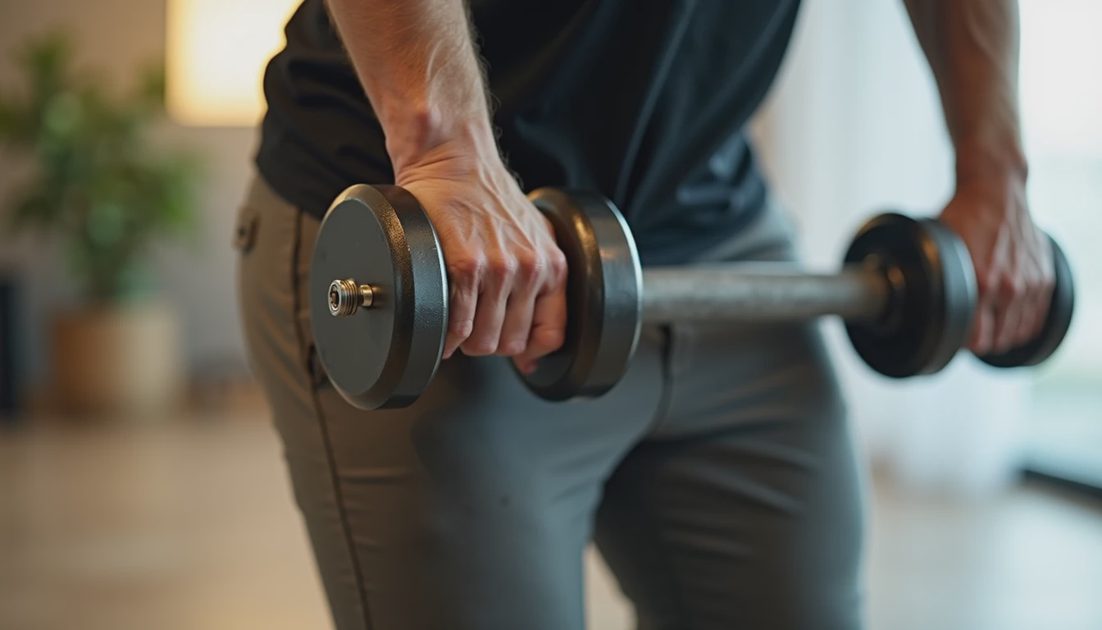
What it is: Any movement where you pick up weight and walk with it.
Muscles worked: Core, grip, shoulders, upper back, entire stabilizing system.
Why it matters: The carry is the most underrated exercise in existence. It doesn't look impressive. It doesn't feel like you're "working out." But it builds functional core strength better than any crunch ever will. It improves posture, grip strength, and overall stability—things that matter for daily life and long-term health.
How to start (beginner): Farmer's carry. Pick up a dumbbell in each hand, stand tall, brace your core, and walk for 30–60 seconds. Keep your shoulders back and your gaze forward. Rest, repeat. Three rounds.
How to progress: Increase weight or distance → Single-arm carry (one dumbbell, one side at a time).
Your One Change for This Week
Don't overhaul your entire routine. Change one thing.
This week: Pick two days and do one exercise from each of the five patterns. That's five exercises per session. Three sets of 10–12 reps each.
Here's a template:
Movement | Exercise (Beginner) | Sets x Reps |
|---|---|---|
Squat | Goblet Squat | 3 x 10–12 |
Hinge | Dumbbell RDL | 3 x 10–12 |
Push | Incline Push-up | 3 x 8–15 |
Pull | Dumbbell Row | 3 x 10–12 |
Carry | Farmer's Carry | 3 x 30–60 sec |
That's it. Fifteen sets. Forty-five minutes. Two days this week.
Next week, do the same thing—but add one rep to each set, or add five pounds.
Do that for 12 weeks, and I promise you: your body will look different. Not because you did 47 different exercises. Because you did the right five, consistently, and got a little stronger every single week.
You don't need variety. You need consistency. You don't need 15 exercises. You need five.
Eat enough. Train hard. Repeat.
No comments yet — be the first to share a thought.