The weight room intimidates a lot of people. The equipment looks complicated. Everyone else seems to know what they’re doing. And the idea of loading a barbell for the first time feels like stepping into a world you don’t belong in.
You do belong there.
Strength training is one of the highest-leverage things you can do for fat loss and long-term health, especially if you’re over 30. It helps preserve muscle while you lose fat, improves how your body looks and functions, and makes daily life easier. You do not need to become a powerlifter. You just need to start.
Here’s a practical way to begin if you’ve never touched a barbell—or any serious weight training—before.
Start With Machines or Dumbbells First
You do not have to walk up to a loaded barbell on day one.
Most beginners do better starting with:
Machines (leg press, chest press, seated row, lat pulldown)
Dumbbells
Resistance bands
Bodyweight movements
These options reduce the technical demand while still training the major muscle groups. Once the basic patterns feel familiar and your confidence grows, transitioning to free weights and barbells becomes much less intimidating.
The goal in the first month is not to impress anyone. It is to show up, learn the movements, and leave the gym knowing you did the work.
Master These Five Movement Patterns
Almost every useful strength exercise fits into one of these categories:
Squat / Knee-dominant – Leg press, goblet squat, bodyweight squat, or leg extension
Hinge / Hip-dominant – Romanian deadlift with dumbbells, hip thrust, or back extension
Push – Push-up, dumbbell bench press, chest press machine, or overhead press
Pull – Seated row, lat pulldown, dumbbell row, or band pull-apart
Carry or Core – Farmer carry, plank, or dead bug
A simple full-body session might include one exercise from each category. Two or three sets of 8–12 controlled reps is enough to start.
Focus on feeling the target muscles working. Move through a full range of motion you can control. When in doubt, go lighter and slower.
Learn Form Before You Add Weight
Ego is the fastest way to get hurt or discouraged.
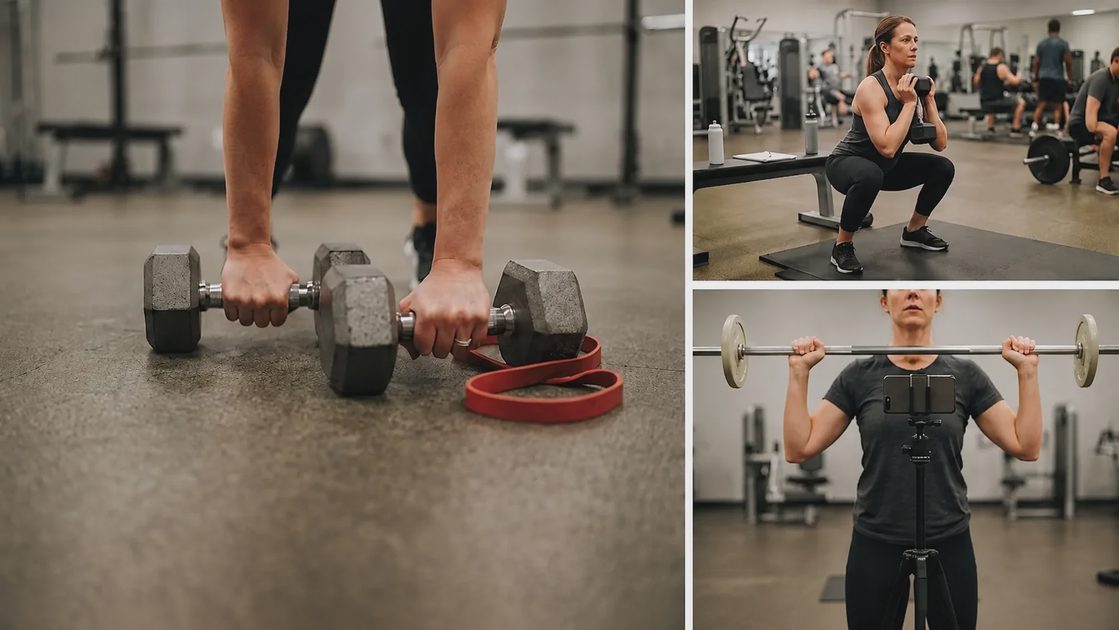
Film yourself from the side on a couple of sets. Compare what you see to reliable form videos from credible coaches. If something feels wrong in your joints rather than challenging in your muscles, reduce the load or simplify the movement.
A small amount of muscle soreness in the days after a session is normal when you’re new. Sharp joint pain is not. Stop any movement that produces the latter and adjust.

How Often and How Hard
Two full-body sessions per week is an excellent starting point. Three is better once recovery and schedule allow.
Leave one or two reps in reserve on most sets. You should finish the set knowing you could have done a little more with good form. This approach builds strength while keeping recovery manageable—especially important if you’re also in a calorie deficit for fat loss.
Progress looks like this: same weight for more reps, or a slightly heavier weight for the same reps, over time. Write down what you do. Next session, try to improve by a small amount.
What to Do About the Gym Environment
If the main floor feels overwhelming, start in a quieter area or during off-peak hours. Many gyms have machine circuits or beginner-friendly zones. Headphones are allowed. You do not need to make small talk.
If a commercial gym still feels like too much, begin at home with dumbbells or adjustable weights. Plenty of effective programs require minimal equipment. The best starting place is the one you will actually use.
Common Beginner Mistakes to Avoid
Doing too much too soon and ending up too sore to return
Copying advanced lifters’ programs or ego-lifting heavy weights with poor form
Skipping the warm-up sets
Expecting dramatic visible changes in two weeks
Treating strength training as cardio by rushing through sets with no focus on tension
Consistency beats intensity at this stage. A simple program done regularly will outperform a complicated one done sporadically.
Your One Action This Week
Schedule two 30–40 minute sessions. Choose one exercise for each of the five movement patterns above. Perform 2–3 sets of 8–12 controlled reps. Write down the weights and reps you used.
That’s it. No perfect program required. No barbell required on day one.
Show up twice. Learn the movements. Leave knowing you started.
The people who transform their bodies over years are not the ones who waited until they felt ready. They are the ones who began while still unsure and kept going.
You can do the same.
Eat enough. Train hard. Repeat.


No comments yet — be the first to share a thought.