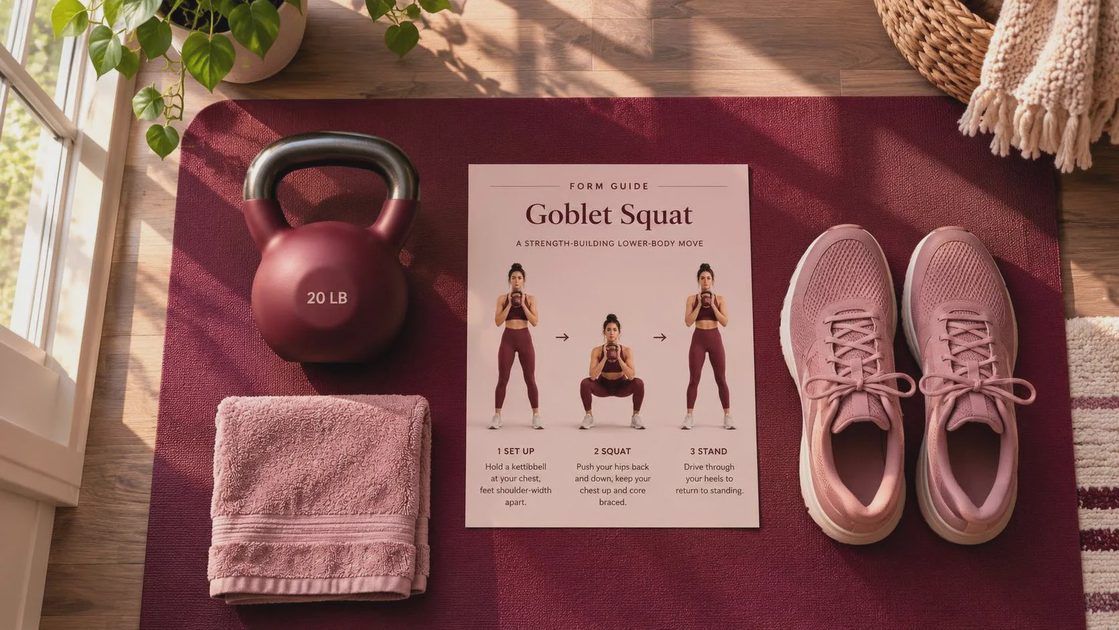
If you want one lower-body exercise that teaches good mechanics without requiring a rack, the goblet squat is a very good place to start. You hold one dumbbell or kettlebell at your chest, squat under control, and stand. No circus tricks, no special program, and no promise of a six-pack by next Tuesday. The goblet squat builds useful leg strength, reinforces balance, and fits into a busy Tuesday workout.
I have used this movement with beginners, returning exercisers, and plenty of people who were intimidated by barbell squats. The goal is not to make the exercise look dramatic. The goal is to train consistently, add sensible resistance, and eat in a way you can repeat. Eat enough. Train hard. Repeat.
Why the goblet squat deserves a place in your program
The goblet squat trains your quadriceps, glutes, adductors, and core while giving you a straightforward way to practice squatting. Because the weight sits in front of your chest, it provides a useful counterbalance. Many people can keep their torso more upright and reach a comfortable depth before they are ready for a loaded barbell.
That does not make the movement easy. Your legs still have to produce force, and your trunk has to stay braced while you move through the range of motion. A challenging set of 10 can raise your heart rate quickly, especially when you are not resting five minutes between sets.
The exercise is also equipment-friendly. One 20- to 35-pound dumbbell can provide a meaningful workout for a new lifter, while a stronger trainee can use a 50- or 70-pound kettlebell. If your gym has limited equipment, the goblet squat still gives you a reliable lower-body option.
How to perform a goblet squat correctly
Stand with your feet about shoulder-width apart, or slightly wider if that lets you move comfortably. Hold the handle of a kettlebell or one end of a dumbbell with both hands. Keep the weight close to your sternum, not drifting several inches away from your body.
Take a breath into your belly, gently brace your midsection, and unlock your knees. Lower by bending your knees and hips together. Keep your whole foot connected to the floor, with pressure through the heel, base of the big toe, and base of the little toe. Your knees should track in the same general direction as your toes.
Descend only as far as you can control without your heels lifting, your back collapsing, or your knees caving inward. Depth is not a moral achievement. If your hips reach the level where your thighs are roughly parallel to the floor, that is plenty for many people. Drive through the floor and finish tall without leaning backward.
A slow three-second lowering phase is an excellent way to learn the goblet squat. It exposes the usual shortcuts: dropping too fast, relaxing at the bottom, or letting the weight pull you forward. Film one set from the side if you are unsure. You are looking for a stable foot, controlled depth, and a torso that remains organized rather than perfectly vertical.
Sets, reps, and loading that make sense
For general strength and muscle, start with three sets of eight to 12 repetitions. Rest about 90 seconds between sets. Choose a load that leaves roughly two good repetitions in reserve. In plain English, you should finish the set knowing you could perform two more clean reps, but not eight more.
If you are brand new, use a light dumbbell or even a household object for the first session. Ten pounds is not embarrassing; using a weight you cannot control is simply poor training. Once you can complete three sets of 12 with consistent depth and no form breakdown, increase the load by five pounds if possible.
Another option is to keep the weight the same and add a pause. Hold the bottom position for one second, then stand. Pauses increase control without requiring a heavier implement. You can also use a four-second lowering phase for a short training block. Do not add every challenge at once. Your joints and connective tissues need time to catch up with your ambition.
For a practical full-body session, pair the goblet squat with a dumbbell row, incline push-up, Romanian deadlift, and brisk five-minute walk. Perform two or three rounds. This will not replace every form of training, but it is far more useful than waiting for the perfect program to appear on social media.
Common mistakes and simple fixes
The first common mistake is holding the weight too far away. That turns a manageable squat into an awkward front-loaded lever. Pull the dumbbell or kettlebell close to your chest and keep your elbows pointed generally toward the floor.
The second is chasing depth at the expense of control. A deep goblet squat is not automatically better than a comfortable, stable one. Reduce the range slightly, slow down, and work on ankle mobility if your heels lift. A small weight plate under the heels can be a temporary teaching tool, but it should not hide a persistent mobility or pain problem.
The third mistake is treating every repetition like a race. Bouncing out of the bottom and snapping the knees straight does not earn bonus points. Use a controlled descent, a brief transition, and a strong stand. If you feel sharp knee, hip, or back pain rather than ordinary muscular effort, stop and get an assessment from a qualified clinician.
A fourth mistake is changing exercises every week. Keep the goblet squat in your routine for at least four to six weeks. Consistency gives you something to measure, and measurement beats guessing.

The goblet squat and fat loss
The goblet squat can help preserve or build muscle while you lose fat, but it is not a fat-burning loophole. Your weekly calorie balance still matters. A hard set might feel exhausting, yet exercise calories are easy to overestimate and easy to eat back with a large coffee drink and a handful of snacks.
Use the movement as part of a realistic plan. Aim for a protein source at each meal, plenty of produce, and a calorie deficit you can maintain without constant hunger. For many adults, losing roughly 0.5 to 1 percent of body weight per week is an aggressive enough target; slower progress is still progress.
Strength training also gives your body a reason to retain muscle during weight loss. Two or three full-body sessions each week, regular walking, and adequate protein will do more for your long-term result than a punishing workout followed by a weekend of restriction and overeating.
Your one change for this week
Schedule two goblet squat sessions on nonconsecutive days. In the first session, perform three sets of eight with a manageable weight and a three-second lowering phase. In the second, perform three sets of 10 using the same load if your form remains steady. Write down the weight, repetitions, and how many clean reps you had left.
Do not add extra sets because you feel guilty about yesterday’s dinner. Do not slash your calories because a scale reading moved up after a salty meal. Train, eat regular meals, sleep as well as real life allows, and review the trend after several weeks.
The goblet squat is not a miracle exercise. That is precisely why I like it. It is simple to learn, easy to progress, and difficult to fake when the weight gets challenging. Build your plan around movements you can repeat, food you can live with, and numbers you can track. Then do the boring work long enough for it to matter.
No comments yet — be the first to share a thought.