If you have ever finished a set of bench presses and wondered, does bench press work biceps, the short answer is no—not in any meaningful muscle-building way. The bench press is primarily a chest, front shoulder, and triceps exercise. Your biceps help stabilize the elbow and shoulder, but they are not the muscle driving the bar upward.
That distinction matters. If your goal is stronger arms, doing more bench press alone is like eating salad and expecting it to provide every nutrient you need. It is a useful lift, but it has a job. Train the right muscles with the right exercises, then give your body enough food and recovery to adapt.
What the bench press actually trains
During a standard barbell bench press, you lower the bar toward your chest and then press it away. The pectoralis major produces much of the horizontal pressing force. The anterior deltoid assists at the shoulder, while the triceps extend the elbow to finish the repetition.
Your biceps are on the opposite side of the elbow from the triceps. Their main job is elbow flexion, which means bringing your hand toward your upper arm, as in a curl. In a bench press, the elbow is moving toward extension while you push. That is not the biceps' primary action.
The biceps still have a small supporting role. They can help control the descent, keep the elbow and shoulder organized, and stabilize the arm under load. You might feel tension in them, especially with a heavy barbell, a wide grip, or unfamiliar technique. Feeling a muscle work does not automatically mean it is receiving enough stimulus to grow.
So, does bench press work biceps enough for bigger arms? For most people, no. A beginner might gain some overall upper-body strength from pressing, but direct biceps training will be far more efficient if arm size is the target.
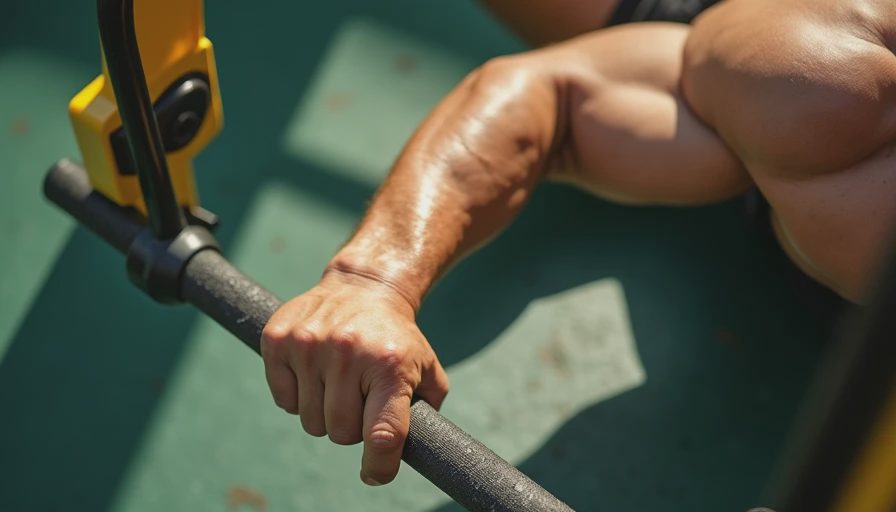
Does bench press work biceps differently with grip changes?
Grip changes alter which muscles contribute, but they do not turn the bench press into a biceps exercise. A close-grip bench press shifts more work toward the triceps because your elbows remain closer to your torso and the elbow extension demand increases. It can be a useful variation for pressing strength and arm development, but the biceps still are not the prime mover.
A very wide grip can increase chest involvement and reduce the distance the bar travels, but it may also place more stress on the shoulders if your mobility and control are poor. It does not create a better biceps stimulus. The same principle applies to dumbbell bench presses, machines, and push-ups: these are pressing movements, so the chest, shoulders, and triceps do most of the work.
Use the grip that lets you press with control. Keep your wrists stacked over your forearms, lower the weight to a consistent point, and stop treating every exercise as a secret shortcut. There is no prize for discovering that a chest exercise somehow replaces curls.
The best exercises for building biceps
If you want stronger or larger biceps, train elbow flexion directly and train the muscles through a comfortable range of motion. You do not need a circus routine or a shelf of supplements. Two or three exercises per week can work well.
Start with one curl that keeps your upper arm relatively still. Dumbbell curls allow each arm to work independently and expose strength differences. Use a weight you can control for 8 to 12 repetitions, lowering for about two seconds instead of dropping the dumbbells.
Add an exercise that places the shoulder in a different position. Incline dumbbell curls lengthen the biceps because your arms begin behind your torso. Preacher curls limit cheating and make the lower portion of the movement demanding. Hammer curls use a neutral grip and train the brachialis and brachioradialis along with the biceps, which can contribute to a thicker-looking upper arm.
A practical starting plan is two sets of dumbbell curls and two sets of hammer curls after an upper-body workout. When you can complete the top end of your rep range with clean form, increase the load by the smallest available increment. That is progressive overload without the nonsense.
How to combine bench press and biceps training
You can train both in the same workout without making the session complicated. Begin with your main strength movement while you are fresh. For example, perform bench press for three sets of five to eight repetitions, resting two to three minutes between sets. Follow it with a row or pulldown, then finish with direct arm work.
Here is a simple upper-body session:
- Barbell bench press: 3 sets of 5 to 8 reps.
- One-arm dumbbell row: 3 sets of 8 to 12 reps per side.
- Dumbbell shoulder press: 2 sets of 8 to 10 reps.
- Cable pulldown: 3 sets of 8 to 12 reps.
- Incline dumbbell curl: 2 sets of 10 to 12 reps.
- Rope hammer curl: 2 sets of 10 to 15 reps.
This gives your pressing muscles focused work and your biceps direct work. If you bench twice weekly, you do not need to add curls after every set. Place biceps training after one or both sessions, depending on your recovery and total pulling volume.
Does bench press work biceps enough to count toward your weekly biceps sets? I would not count it that way. Count direct curls first, then consider the indirect fatigue from rows and pulldowns. A reasonable starting point for many adults is roughly six to ten challenging direct biceps sets per week, adjusted for experience, soreness, and performance.
Form mistakes that steal progress
The most common mistake is swinging the weight. A heavy curl with your hips snapping forward is not automatically better than a lighter curl you can control. Keep your ribs down, brace your midsection, and let the elbow bend and straighten without turning the exercise into a full-body heave.
Another mistake is stopping every set too early. You do not need to reach failure on every repetition, but your final few reps should be difficult while remaining technically sound. Leaving five easy reps in reserve forever will not provide much reason for the muscle to adapt.
For the bench press, avoid bouncing the bar off your chest or flaring your elbows aggressively. Set your shoulder blades, keep your feet stable, and use a range of motion you can control. If the movement causes sharp pain, stop and get qualified instruction rather than trying to out-stubborn an irritated joint.
Eat enough, train hard, repeat
Muscle growth requires training, recovery, and adequate energy. Include a protein source at each meal: Greek yogurt, eggs, tofu, beans, fish, chicken, or lean meat all work. A useful general target for active adults is about 20 to 40 grams of protein at a meal, depending on body size and total daily needs.
You do not need a dirty bulk, a detox, or a $70 tub of powder with a lightning bolt on the label. If you are trying to lose fat, use a modest calorie deficit and keep lifting. Your goal is not to punish your body until it cooperates. It is to preserve muscle while building habits you can repeat on a busy Tuesday.
So, does bench press work biceps? It involves them a little as stabilizers, but it is not a biceps builder. Keep the bench press for chest, shoulders, and triceps, then add controlled curls and hammer curls for direct arm work. Track your repetitions, add weight gradually, eat enough protein, and give the plan several months instead of abandoning it after three workouts. Eat enough. Train hard. Repeat.
No comments yet — be the first to share a thought.