A chest and bicep workout does not need to leave you unable to lift a grocery bag for three days. It needs a sensible exercise order, enough hard sets, and a plan for adding resistance over time. If you are 30, 40, or 50 and trying to build strength while managing work, kids, and dinner, consistency beats a dramatic session you cannot repeat.
I have watched people chase complicated routines for years. The usual pattern is familiar: six exercises, endless drop sets, a sore shoulder, then two weeks away from the gym. Skip that circus. This chest and bicep workout uses basic movements, controlled effort, and a schedule that can survive a busy Tuesday.
The training structure
Perform this routine once or twice each week, leaving at least 48 hours before training the same muscles hard again. Start with five to eight minutes of easy cardio, followed by shoulder circles, band pull-aparts, and two light practice sets of your first press. Warm-ups should prepare you, not exhaust you.
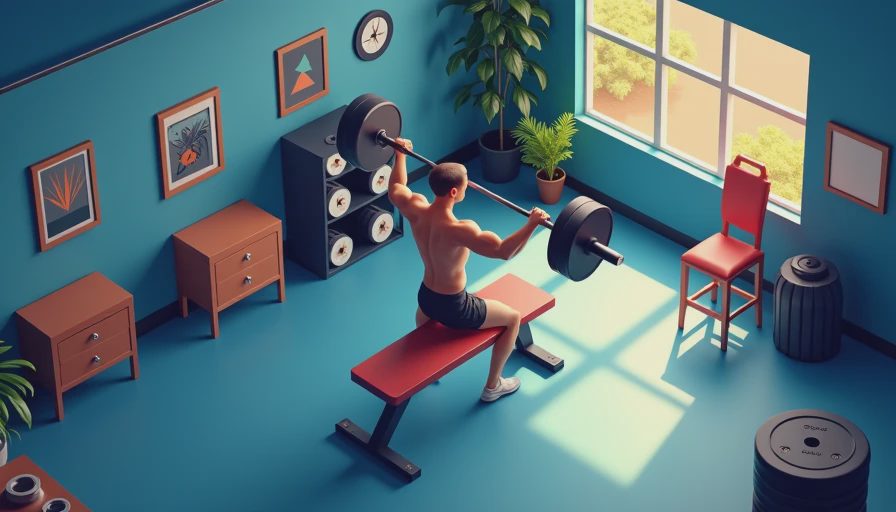
Begin with the barbell bench press or a machine chest press for three sets of six to eight repetitions. Rest two to three minutes between sets. Next, use an incline dumbbell press for three sets of eight to ten. The incline should be modest; a steep angle often turns the exercise into a front-shoulder workout.
Finish the chest work with cable flyes or a pec-deck machine for two sets of 12 to 15. Move slowly and stop when your upper arms are roughly in line with your torso. You do not need to force a huge stretch to make the set productive.

Add biceps without wasting the session
After pressing, your biceps are fresh enough for direct work, but your elbows are already warm. Use alternating dumbbell curls for three sets of eight to 12 repetitions. Keep your upper arms still and lower each weight for about two seconds. If your back is swinging, the dumbbells are too heavy for the job.
Follow with incline dumbbell curls or a preacher curl machine for two sets of 10 to 12. These exercises place the biceps under meaningful tension when the muscle is lengthened, so use a manageable weight. Finish with hammer curls for two sets of 12 to 15. Hammer curls train the brachialis and forearm muscles as well as the biceps, which can improve the overall look and strength of your arm.
This chest and bicep workout gives you 8 direct chest sets and 7 direct biceps sets. That is enough for progress when the sets are challenging and your recovery is adequate. More is not automatically better. A person sleeping five hours and eating too little does not need 25 extra sets; they need a plan they can recover from.
How hard should the sets feel?
Leave one to three good repetitions in reserve on most working sets. In plain English, finish the set knowing you could have performed one, two, or perhaps three more clean repetitions. You do not need to train to failure on every exercise. Going all the way to failure occasionally is reasonable on a stable machine or cable movement, but repeated failure on heavy bench presses can make fatigue and technique problems pile up.
Choose a load that lets you stay inside the stated repetition range. If you can bench 135 pounds for eight repetitions with clean control, keep that weight until you can reach eight on all three sets with solid form. Then add five pounds the next time, or use the smallest plates available. For dumbbells, moving from 25 to 30 pounds can be a substantial jump, so first add repetitions before increasing weight.
A chest and bicep workout should feel demanding, not chaotic. Stop a set if your shoulders lose position, your elbows hurt sharply, or the weight starts moving through momentum rather than muscle control. Ordinary effort discomfort is different from pain that changes your movement.
Progression that works in real life
Use double progression. Pick a repetition range, such as eight to 12, and keep the same weight until you reach the top of that range for every set. Then increase the load slightly and begin again near the lower end. Write the exercise, weight, repetitions, and date in your phone. Memory is a terrible training log, especially when every week feels like a blur of school pickups and meetings.
For example, your dumbbell curl might look like this: 20 pounds for 10, 9, and 8 repetitions in week one; 20 pounds for 11, 10, and 9 in week two; and 20 pounds for 12, 12, and 11 in week three. Keep the weight for another session, reach 12 on all sets, then try 22.5 pounds. That is progress without a heroic workout.
If your numbers stall for three consecutive workouts, look at sleep, food, and exercise technique before adding more volume. A lighter week with two fewer sets can also help. Deloading is not quitting; it is how you clear accumulated fatigue and return ready to train.
Eat enough to support the work
Muscle growth requires training plus adequate energy and protein. You do not need a supplement cabinet. Include a protein source at three or four meals: Greek yogurt at breakfast, turkey or beans at lunch, cottage cheese or tofu as a snack, and chicken, fish, lean beef, or lentils at dinner. A practical target for many active adults is roughly 25 to 40 grams of protein per meal, adjusted for body size and medical needs.
Put carbohydrates around training if they help you perform. A banana and yogurt before the gym, or rice and eggs afterward, is not a failure of discipline. It is usable fuel. If fat loss is your goal, create a modest calorie deficit rather than trying to survive on coffee and lettuce. Losing weight while preserving muscle is slower than crash dieting, but it is far more useful.
Hydrate normally, sleep as consistently as your life allows, and do not mistake soreness for results. The chest and bicep workout is only one piece of the week. Walk, train your back and legs, and keep daily movement high enough to support your health.
Your one change this week
Schedule two sessions now, even if the second is a shorter version. In the first session, complete the full routine. In the second, do two sets of bench press, two sets of incline pressing, two sets of curls, and two sets of hammer curls if time is tight. A reduced workout keeps the habit alive; skipping because the perfect 75-minute window disappeared does not.
Track your sets for four weeks before judging the plan. You are looking for cleaner repetitions, slightly heavier loads, or more total repetitions at the same weight. Those are real wins, even when the mirror changes slowly. Eat enough. Train hard. Repeat. That is the chest and bicep workout approach that holds up after the novelty wears off.
No comments yet — be the first to share a thought.