If you want stronger legs, better balance, and a workout that does not require a room full of machines, the bulgarian split squat deserves a place in your week. It looks simple: one foot on the floor, the other behind you on a bench, then lower and stand. Simple does not mean easy. This exercise can expose weak hips, shaky balance, limited ankle mobility, and a habit of letting your stronger leg do all the work.
That is useful information, not a reason to feel bad about your body. You do not need a dramatic transformation plan. You need a repeatable movement, sensible loading, enough protein, and patience. Eat enough. Train hard. Repeat.
What the Bulgarian Split Squat Actually Trains
The bulgarian split squat is a single-leg squat variation. Your front leg handles most of the force while the rear leg rests on a bench or sturdy pad for balance. The quadriceps straighten your knee, the glutes extend your hip, and the hamstrings help control the descent. Your trunk and smaller hip muscles work to keep you from tipping sideways.
It is not a perfect test of athleticism, and it is not magic for fat loss. No exercise selectively burns fat from your thighs. Fat loss comes from a sustainable calorie deficit over time, while strength training helps you maintain muscle as your body weight changes. The exercise earns its spot because it trains several useful qualities at once: leg strength, coordination, range of motion, and side-to-side control.
Compared with a two-leg squat, the bulgarian split squat often lets you train hard with less total weight. That can be helpful if heavy barbell squats irritate your back or if you train at home with adjustable dumbbells. It also gives you a quick comparison between sides. If your left leg handles eight controlled repetitions and your right leg manages only five, your program has found something worth addressing.
How to Set Up Without Making It a Circus
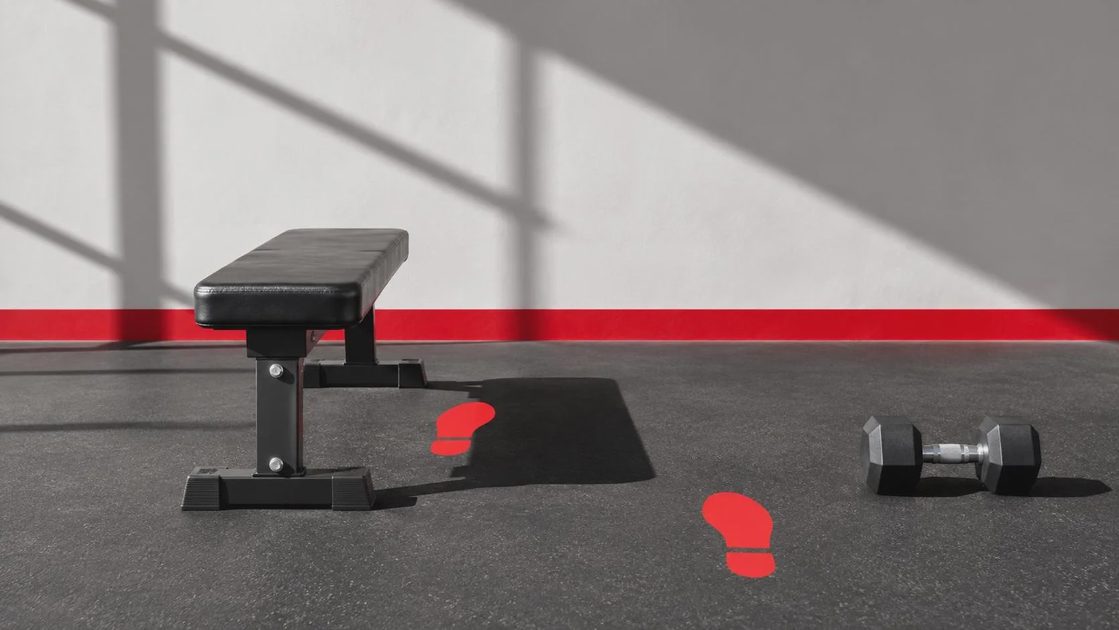
Use a bench that is roughly knee height or slightly lower. A high bench can force your back leg into an uncomfortable stretch and encourage you to arch your lower back. Stand about two to three feet in front of the bench, then place the top of your rear foot behind you. Your front foot should be far enough forward that your heel stays down as you lower.
Start with body weight. Keep most of your attention on the front leg rather than pushing aggressively from the rear foot. Brace your midsection, keep your chest comfortably lifted, and lower under control for about two seconds. Descend until your front thigh is near parallel with the floor, or stop earlier if your heel lifts, your pelvis twists, or your knee becomes painful. Press through the whole front foot to stand.
A slight forward torso lean is normal. It can help you use the glutes and keep your center of mass over the working leg. The goal is not to look perfectly upright for a camera. The goal is a stable, pain-free repetition that you can repeat next week.
The Beginner Prescription: Sets, Reps, and Progression
For your first two weeks, perform two sets of six to eight repetitions per side, two or three days apart. Rest 60 to 90 seconds between sides or sets. Hold onto a wall or the back of a chair if balance is the limiting factor. That is not cheating; it lets your legs train instead of turning the exercise into a wobbling contest.
Once you can complete two sets of 10 repetitions per side with steady control, add load. Two dumbbells held at your sides are the simplest option. Begin with a weight that leaves approximately two good repetitions in reserve. For many beginners, that might be 10 to 20 pounds total, but the correct load depends on your current strength and range of motion.
The bulgarian split squat works well in a lower-body session after a warm-up and before small isolation exercises. A practical workout could include a dumbbell Romanian deadlift for three sets of eight, the bulgarian split squat for three sets of eight per side, a glute bridge for two sets of 12, and calf raises for two sets of 12. Add a few minutes of walking before you begin. You do not need a complicated warm-up ritual.

Common Problems and the Fixes That Work
If your front knee caves inward, reduce the weight and slow down. Think about keeping the knee tracking in the same general direction as your second and third toes. Do not force your knee outward so hard that your foot rolls onto its outside edge.
If you feel the exercise mostly in the rear leg, move the front foot farther forward and use less help from the back foot. The rear leg is there for support, not to launch you upward. You can even practice a regular split squat with both feet on the floor before returning to the elevated version.
If balance fails before your muscles work, hold one dumbbell in the hand opposite your front leg or lightly touch a wall. If your back foot feels cramped, lower the bench height or place a folded towel under your ankle. If your knee hurts sharply, stop and choose a pain-free variation such as a step-up or supported reverse lunge. Muscle effort is expected; joint pain is not a badge of honor.
How It Fits Into Fat Loss and Real Life
The bulgarian split squat can strengthen your legs, but it will not compensate for eating far too little all week and then losing control on Saturday. Aim for regular meals built around protein, produce, carbohydrates, and fats. A useful starting point for many active adults is 25 to 35 grams of protein at a meal, adjusted for personal needs and medical guidance.
For a busy parent, two short strength sessions can be enough to make progress. Put a pair of dumbbells near the stairs, train for 25 minutes after work, and stop pretending that a perfect 90-minute program is required. Consistency beats novelty. You do not need a new challenge every Monday, and you certainly do not need a supplement promising to change your metabolism.
Progress can mean adding one repetition, improving balance, using a slightly heavier dumbbell, or controlling the lowering phase more cleanly. Record the exercise, load, repetitions, and how difficult the final set felt. If the numbers slowly improve over eight to 12 weeks, the plan is working.
Your One Change This Week
Choose two nonconsecutive days and practice the bulgarian split squat with body weight. Do two controlled sets per side, using a wall for balance if necessary. Film one set from the side if you want a useful form check, then look for three things: a planted front heel, a controlled descent, and a quiet rear leg.
After that, leave the exercise alone long enough to learn it. Chasing soreness is not training. Chasing perfect form is not training either. Showing up, completing the planned work, eating enough to recover, and adding difficulty gradually is training. The bulgarian split squat is challenging, practical, and entirely sufficient without a gimmick attached. Eat enough. Train hard. Repeat.
No comments yet — be the first to share a thought.