Barbell workouts for arms do not require a six-day bodybuilding split, a cabinet full of supplements, or heroic amounts of free time. You need a barbell, sensible loading, good technique, and enough consistency to repeat the work when Tuesday is busy. The goal is straightforward: train the biceps and triceps through useful movement patterns, add resistance gradually, and eat enough protein to support recovery.
If you are new to lifting, start lighter than your ego suggests. A 20-pound training bar or an empty Olympic bar is plenty for learning control. Your elbows, wrists, and shoulders should feel stable, not sharp or irritated. Muscle soreness is not the scorecard. Better form, more repetitions, or a small weight increase over several weeks is the progress that matters.
What a productive arm session includes
Your upper arm has two major players. The biceps help bend the elbow and pull the hand toward the shoulder. The triceps straighten the elbow and contribute much of the upper arm’s total muscle mass. That means a sensible workout trains both sides rather than spending forty minutes on curls while ignoring pressing strength.
A practical session can begin with the barbell curl, followed by a close-grip bench press, then a lying triceps extension. Add a barbell row if you want more back and biceps work, or an overhead press if shoulder pressing is already part of your week. These movements overlap, which is useful. You do not need ten variations that all irritate the same tendon.
For most adults, two or three working sets per exercise and roughly eight to twelve controlled repetitions is a strong starting point. Rest about ninety seconds between moderate sets and up to two or three minutes after demanding presses. Stop with one or two good repetitions still available instead of turning every set into a shaky contest with gravity.
A simple barbell arm workout for the week
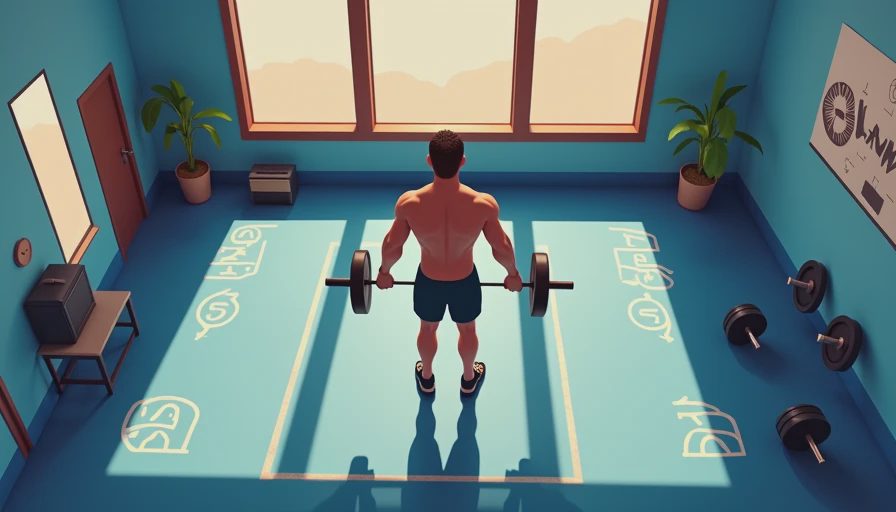
This is one of the barbell workouts for arms I would give a healthy beginner who can train twice weekly. On Monday, perform barbell curls for three sets of eight to twelve repetitions, close-grip bench presses for three sets of six to ten, and barbell rows for three sets of eight to twelve. On Thursday or Friday, repeat curls for two sets of ten to fifteen, overhead triceps extensions for three sets of eight to twelve, and overhead presses for three sets of six to ten.
Warm up with five minutes of easy movement, then complete two or three lighter practice sets before your first heavy exercise. The warm-up sets do not need to tire you out. They are there to rehearse the path of the bar and prepare your joints. Keep your ribs down during overhead work, brace your abdomen, and avoid turning a curl into a full-body swing.
For the curl, stand with feet about hip-width apart and keep your upper arms mostly still. Raise the bar by bending your elbows, pause briefly near the top, and lower it under control. For the close-grip bench press, use a grip that is narrower than your normal bench position but not so narrow that your wrists fold backward. Lower the bar toward the lower chest while keeping your elbows from flaring aggressively.
How to progress without wrecking your elbows
Progression does not mean adding weight every workout no matter what. Use a repetition range. If your plan says eight to twelve reps, keep the same weight until you can complete twelve clean reps on every working set. Then increase the bar by the smallest practical amount, often two and a half to five pounds total, and return to the lower end of the range.
For example, imagine you curl 45 pounds for 10, 9, and 8 reps. Keep that load next time and try for 10, 10, and 9. When you eventually reach 12, 12, and 12 with controlled lowering, add five pounds. The next session might be 9, 8, and 8. That is normal, not failure. Strength builds through repeated exposure, not through pretending every workout is a personal record.
If your elbows become painful, first reduce load and volume. You can also use a slightly different grip, slow the lowering phase, or replace lying extensions with a lighter overhead extension for a few weeks. Persistent or worsening pain deserves assessment from a qualified clinician. Training around discomfort is not a character test.
The nutrition that makes arm training useful
A workout is a signal; food and sleep help you respond to it. Aim for a protein source at each meal, such as Greek yogurt, eggs, chicken, tofu, beans, fish, or lean beef. A useful daily target for many active adults is roughly 1.2 to 1.6 grams of protein per kilogram of body weight, adjusted for health needs and overall diet. You do not need a $60 tub of powder if dinner already contains a solid protein serving.
If fat loss is your goal, use a modest calorie deficit rather than starving through training. A reduction of roughly 250 to 500 calories per day is more compatible with lifting, work, and family life than an extreme crash diet. Include carbohydrates around training, such as oats, potatoes, fruit, rice, or whole-grain toast. They help you bring effort to the session. Drink water, and do not confuse dehydration with discipline.
Sleep matters too. Six hours every night while piling on more sets is not a clever shortcut. Build a routine that gives you a reasonable opportunity for seven or more hours, then judge your plan by your recovery, performance, and ability to repeat it.
Common mistakes that waste your effort
The first mistake is chasing novelty. Switching from curls to a new social-media exercise every week makes progression difficult to track. The second is using too much weight. If your back snaps backward on every curl, your biceps are not receiving the clean workload you think they are. The third is training arms hard every day. Muscles need recovery, and elbows often complain before motivation does.
Another mistake is treating arm size as a separate project from full-body strength. Rows, presses, carries, and push-ups all involve the elbow muscles. A person who trains the whole body two or three times per week often builds a better foundation than someone who performs endless isolation work while skipping legs and back.
Finally, do not measure success only with a mirror. Track your weights, repetitions, sleep, and how your joints feel. A notebook showing a controlled 10-pound increase over three months is more useful than a flattering pump that disappears before dinner.
Your four-week starting plan
For four weeks, perform the workout twice per week with at least one rest day between sessions. In week one, choose conservative weights and leave two repetitions in reserve. In week two, add one repetition to several sets. In week three, add a small amount of weight only where you reached the top of the target range. In week four, maintain the load and focus on smooth technique rather than forcing another increase.
That approach makes barbell workouts for arms repeatable instead of theatrical. You are building a habit that survives deadlines, school pickups, imperfect sleep, and the occasional missed session. If you miss a day, resume at the next planned workout; do not punish yourself with double volume.
The one change to make this week is simple: schedule two 30- to 45-minute sessions, write down every set, and put the barbell back in your hands before you search for another program. Eat enough. Train hard. Repeat.


No comments yet — be the first to share a thought.