
3,500 calories equals one pound of fat. If that feels painfully slow, good—it's supposed to.
Here's the math you've probably heard: 3,500 calories equals one pound of body fat. Cut 500 calories a day, and you'll lose one pound a week. Simple, clean, and entirely too neat for how the human body actually works.
That rule—often called the Wishnofsky Rule—traces back to a 1958 paper. There's just one problem: it's wrong. Or at least, it's way too simple.
Where the 3,500-Calorie Rule Came From
Wishnofsky wasn't trying to mislead anyone. He calculated the energy content of one pound of fat tissue. His math was fine. The problem is the assumption that the human body is a static, predictable machine.
The rule assumes that if you create a 3,500-calorie deficit, exactly one pound of fat disappears. But weight loss isn't linear. Your body adapts. Your metabolism changes.
A 2011 study found that the static 3,500-calorie model significantly overestimates actual weight loss—by 63% in the first year, 346% by year five, and 764% by year ten.
So when you cut 500 calories a day and only lose half a pound that week? You're not failing. The rule is.
Why One Pound a Week Feels So Slow
Let's be honest: one pound a week is slow. Losing 20 pounds takes five months. Losing 40 pounds takes almost a year.
Here's the part nobody tells you: that's the point.
Faster weight loss comes with a hidden cost: muscle loss. A 2024 review found that rapid weight loss can result in 20% to 50% of total weight loss coming from fat-free mass—including skeletal muscle. That's 6 kilograms of muscle gone, a loss comparable to a decade of aging.
Losing muscle matters because muscle is your metabolic engine. Every pound of muscle you lose drops your resting metabolic rate. You burn fewer calories around the clock. Regain becomes easier.
That's the "I lost 20 pounds and gained back 30" phenomenon. You didn't fail. You just lost the wrong tissue.
A 2023 study found that only about 15% of people can sustain a 10% weight loss through non-surgical methods. The strategies that work long-term are the ones that prioritize muscle preservation—not speed.

The Real Math: What Loss Actually Looks Like
Here's what "one pound a week" actually looks like in real life:
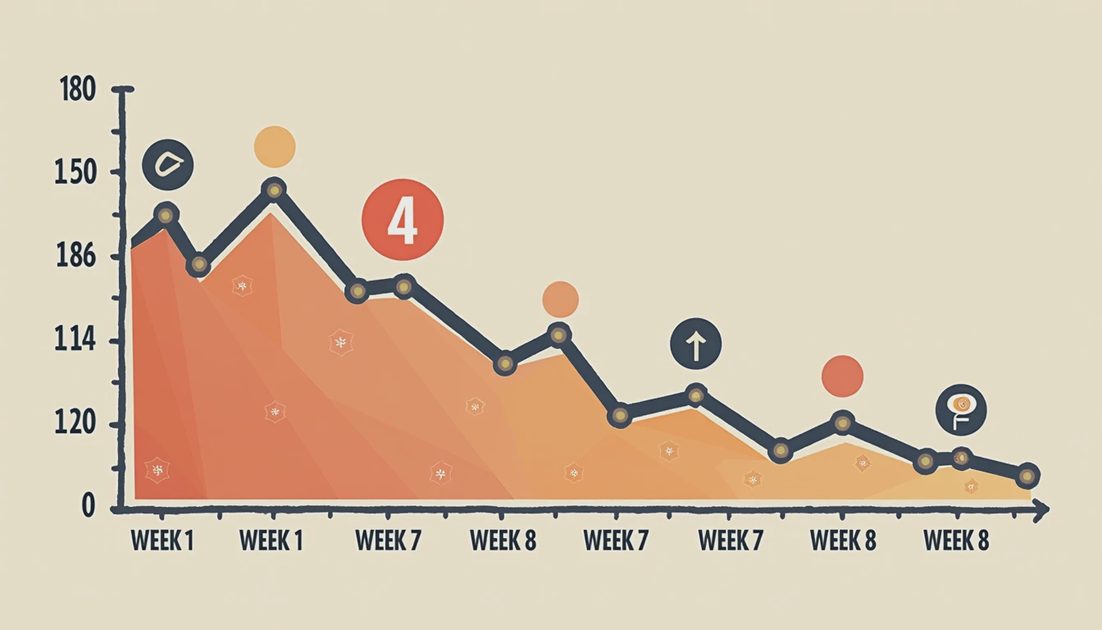
Week 1: You lose 3 pounds. Two are water. One is fat. You feel great.
Week 2: You lose 1.5 pounds. Mostly fat. You feel okay.
Week 3: You lose 0.8 pounds. Your body is adapting.
Week 4: The scale hasn't moved in three days. You're frustrated.
This is normal. It's not a steady downward line—it's a staircase with bumps, plateaus, and the occasional backward step.
A 2013 commentary showed that dynamic models accounting for metabolic adaptation are significantly more accurate than the static 3,500-calorie rule. Your body isn't a calculator. It's a living system.
How to Make One Pound a Week Work
If one pound a week feels slow, here's the reframe: one pound a week is 52 pounds a year.
That's life-changing. Here's how to make it work:
1. Set a moderate deficit. 500 calories. Not 1,000. Sustainable wins.
2. Prioritize protein. 0.7–1g per pound of body weight. Protects your muscle.
3. Train hard. Strength training signals your body to preserve muscle in a deficit.
4. Track trends, not daily numbers. Weigh daily—but look at the weekly average, not the daily spike.
5. Be patient. The slow weeks build the habit. The plateaus test your commitment. Both are part of the process.
Your One Change for This Week
Stop looking at the scale every day and asking "did I lose weight today?"
This week: take a weekly average. Weigh yourself every morning for seven days, add them up, divide by seven. That's your real number. Compare averages week to week, not daily numbers.
One pound a week feels slow because it is slow. But slow is how you keep it off. Slow is how you protect your muscle. Slow is how you build habits that survive a Tuesday.
The honest math isn't 3,500 calories equals one pound. It's consistency plus time equals results.
And that math always works.
Eat enough. Train hard. Repeat.

No comments yet — be the first to share a thought.